I am a historian and PhD Candidate in History at Queen’s University in Kingston, Canada, specializing in Ukrainian and Soviet history, as well as consumption, material culture, and environmental studies. In May 2024, I will be joining the University of Melbourne as an inaugural Mykola Zerov Fellow in Ukrainian Studies. My current research project delves into the history of consumption, materialities, and human-environmental relationships during the Soviet famines in Ukraine. I contextualize this research within the framework of coloniality, food inequality, and human-environment relationships during times of extreme crisis. Additionally, I serve as an editor at H-Ukraine, where I showcase new scholarship, projects, and activities by Ukrainian and international scholars in the area of Ukrainian studies.
I am the inaugural Mykola Zerov Fellow in Ukrainian Studies, generously funded by the Ukrainian Studies Support Fund of the Association of Ukrainians in Victoria, and the Senior Research Fellow at the University of Melbourne. I am also a researcher with the Ukrainian Global History Initiative, where my work focuses on the social history of the 1932–1933 famine, the Holodomor. I am a historian of Ukraine and the Soviet Union specialiazing in environmental history, material culture, and history of famine.
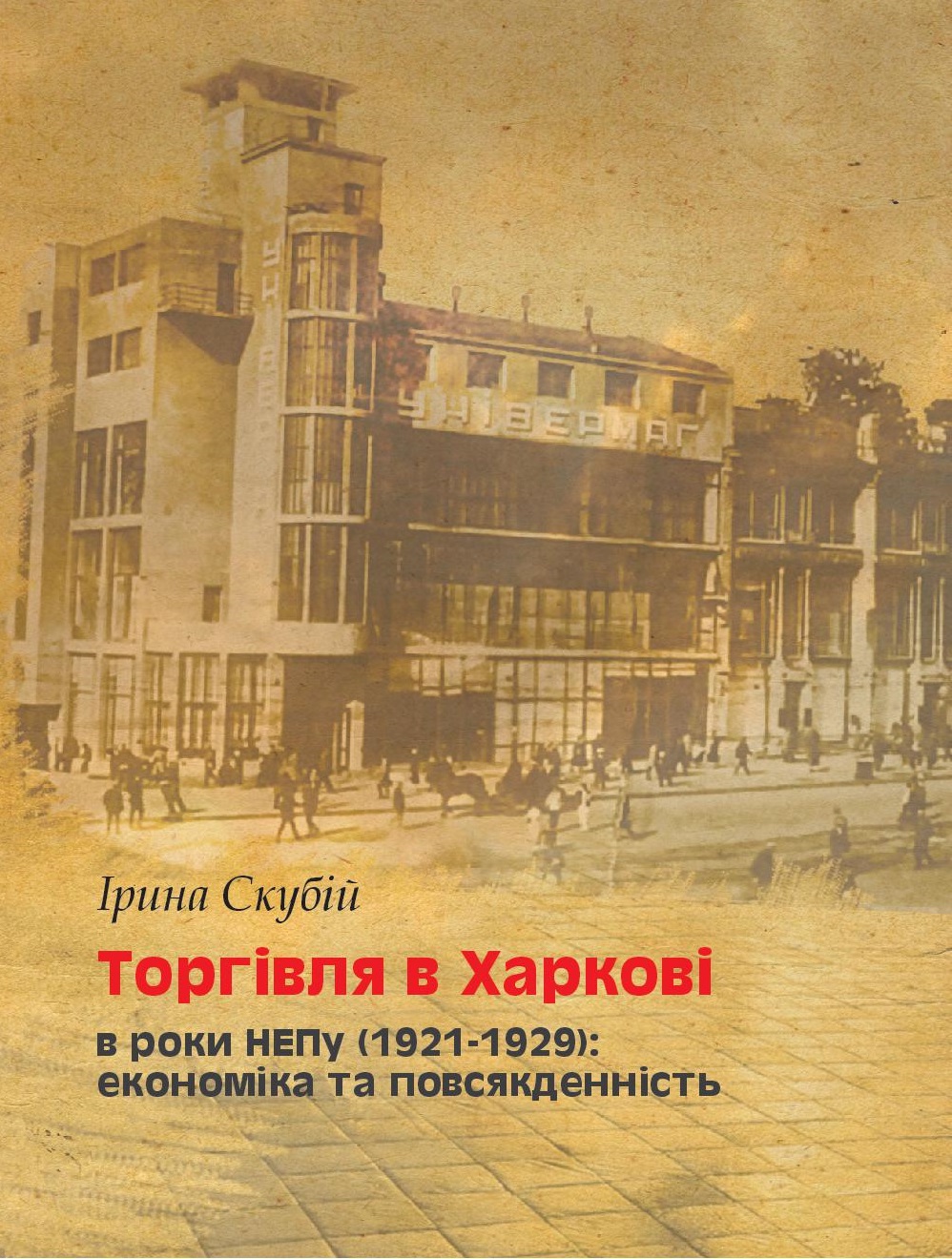
I obtained my PhD in History from Queen’s University, Kingston, Ontario (Canada) and a Candidate of Science Degree in History from V.N. Karazin Kharkiv National University (Ukraine). I have taught and held research positions in Ukraine, Germany, Poland, Austria, and Canada. Recognized by the American Association for Ukrainian Studies for the best article in Ukrainian studies, I am currently working on two books: one based on my dissertation, Survival Under Extremes: Human, Environmental, and Material Relationships Amidst the Soviet Famines in Ukraine, and another focused on the history of consumption and material culture in early Soviet Ukraine. My first monograph, Trade in Kharkiv in the Years of NEP: Economy and Everyday Life” [Torhivlia v Kharkovi v roky NEPu (1921–1929): ekonomika ta povsiakdennist’] (2017), examined the economy, trade relationships, and everyday life in early Soviet Ukraine. My research explores how people, landscapes, and objects shaped everyday life under Soviet rule, especially during extreme events such as famines.
I also write and speak widely for both scholarly and public audiences, contributing to international debates on decolonisation, famine, food security, and environment, Russia’s war against Ukraine, including its impact on Ukraine and its global political and environmental contexts.
Latest News
In 2025, I received the American Association of Ukrainian Studies award for the Best Article, ‘Food Waste and Survival in Times of the Soviet Famines in Ukraine,’ published in the Journal of Contemporary History in 2024.
The Prize Committee described the article as:
“[…] an extraordinary piece of interdisciplinary research linking famine studies, waste studies, environmental history, and survival strategies in scrutinizing the complex and rapidly changing relationship(s) to food waste during the three consecutive Soviet famines in Ukraine. The meticulous and empirically rich study of the relationship(s) between humans and food, humans and waste, humans and nature – and between the state and food waste – in times of extreme (state-instigated) famine works as a metaphorical “slap on the face” for the reader. By approaching the Soviet famines through the original prism of food waste, this article sheds new light on the scale of violence, pain and damage incurred upon the people of Ukraine at the time – and the lasting legacies of the survival strategies developed in response (as acknowledged by members of the selection committee when reflecting on the relationship to food waste cultivated in their own families decades later).”
What I work on?
Extremes of Famine Survival in Soviet Ukraine
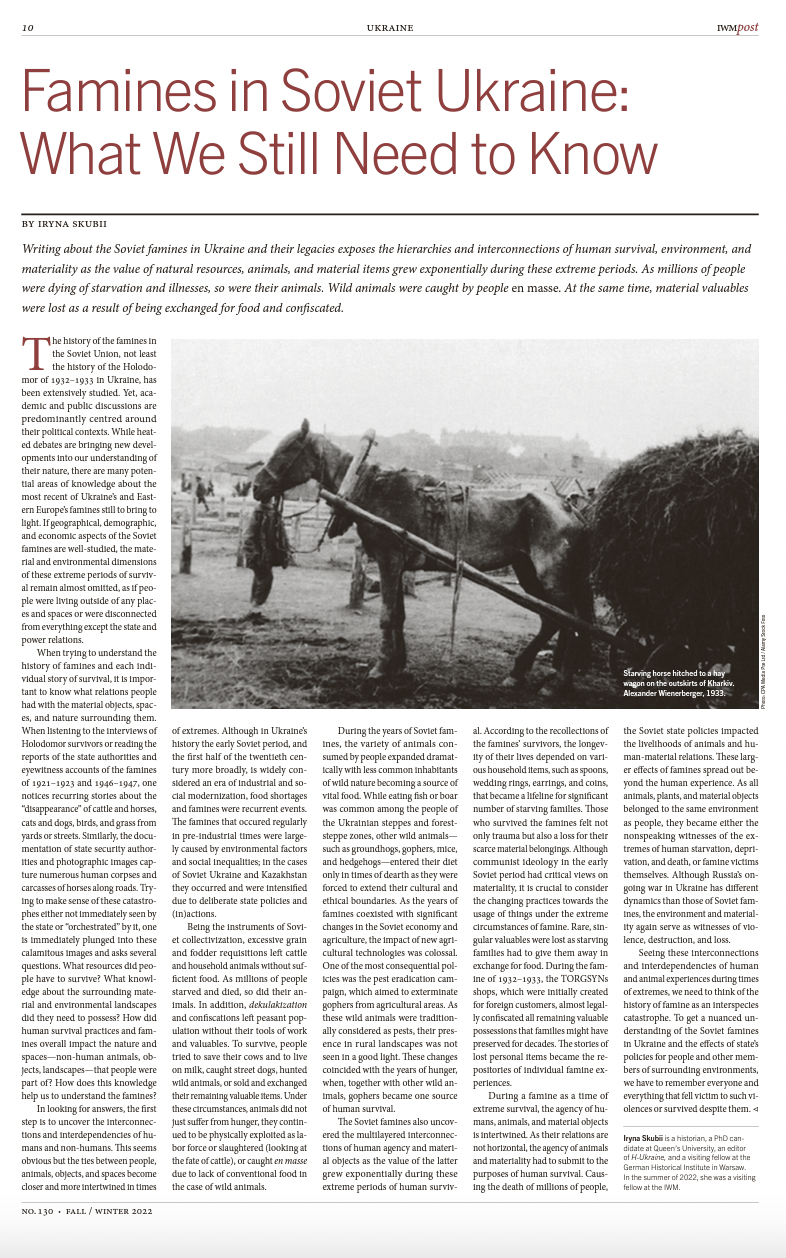
My recent doctoral project, Survival Under Extremes: Human, Environmental, and Material Relationships Amidst the Soviet Famines in Ukraine (Queen’s University in Kingston, 2024), explored how Ukrainians coped with the devastating Soviet famines of the twentieth century — using survival practices, material valuables, and the environment to survive under extreme conditions. The thesis has been shortlisted for The Philippa Hetherington Prize by the Australian Historical Association (2025) as the best postgraduate thesis in general history (excluding Australian history). I am currently preparing a manuscript based on this research for publication with an academic press.
Early Soviet Ukrainian Consumption and Material Culture
Drawing on nearly a decade of research and numerous publications, this project explores the early decades of Ukrainian Soviet consumption and material culture. I am currently finalising the manuscript for publication with a Ukrainian academic press.
For publications on this project, see my Google Scholar or Academia.edu profiles.
The Environmental History of the Sunflower and Monocultures
My most recent project traces the sunflower’s journey from an unfamiliar plant on Ukrainian soil to a dominant monoculture and a powerful postcolonial symbol. It is a story of land, agriculture, food, and meaning — deeply rooted in Ukraine, yet resonating globally.
In October 2024, I gave the inaugural Mykola Zerov lecture at the University of Melbourne titled “The Tale of the Sunflower and Its Travels in Ukraine.”
In September 2025, I will give a public lecture “From an Exotic Plant to a Symbol of Modern Culture: A Brief History of the Sunflower in Ukraine” at the Centre of Urban History of Eastern Europe (Lviv, Ukraine).
Oral History of the Ukrainian Community in Australia Through the Memory of the Descendants
Project team: Emeritus Professor in Ukrainian Studies Marko Pavlyshyn, Dr. Olha Shmihelska-Kozuliak, Dr Yana Ostapenko.
The project is devoted to studying the history of the Ukrainian community of Australia with a focus on the transmission of memory of survival of the Holodomor and the displacement after the WWII. It is generously supported by the Ukrainian Studies Support Fund of the Association of Ukrainians in Victoria.
Interview about the project with Dr Olha Shmihelska-Kozuliak for SBS Ukrainian, 10 July 2025. https://www.sbs.com.au/language/ukrainian/uk/podcast-episode/oral-history-of-the-ukrainian-community-in-australia-through-the-memory-of-the-descendants/hju3
Association of Ukrainians in Victoria Archive as a Source of Community Memory and Knowledge on the Defence of Human Rights in Ukraine
This project examines the history of human rights activism among the Ukrainian community of Victoria. It is generously supported by the Ukrainian Studies Foundation of Australia.
Holodomor – Social History. Ukrainian Global History Initiative
Research capsule: Dr Daria Mattingly (University of Chichester), Dr Artem Kharchenko (I.Kotliarevsky Kharkiv National Academy of Arts).
Our research team seeks to provide new empirical and conceptual understanding about the social history of the famine of 1932-1933, Holodomor, in Soviet Ukraine. About the Ukrainian Global History Initiative and its objectives see here.
War, Material Culture, & Environment
As a scholar from Ukraine, I contribute to conversations on the impact of the Russo-Ukrainian War on the environment, animals, and material culture. I am working on a paper on material objects and memory of home in the oral histories of Ukrainians displaced by the Russo-Ukrainian War.
Recent & Forthcoming Events
To access information about the events I have contributed to and organized, please refer to the Events page. For details on my most recent presentations, public talks, and associated videos, visit the Conferences and Public Talks section.
Latest Publications
“Towards an Animal Sensitive History of Famines: Animals, the Environment, and Soviet Famines in Ukraine.” East/West: Journal of Ukrainian Studies. Special Issue: Beyond Anthropocentrism in Ukrainian Studies (ed. by Tanya Richardson and Darya Tsymbalyuk) (2025) (forthcoming, pre-print LINK )
“Food Waste and Survival in Times of Soviet Famines in Ukraine.” Journal of Contemporary History. Special Issue: Waste Management, ed. by Iris Borowy and Viktor Pal) (2023). American Association for Ukrainian Studies awarded the 2025 Prize for the Best Article.
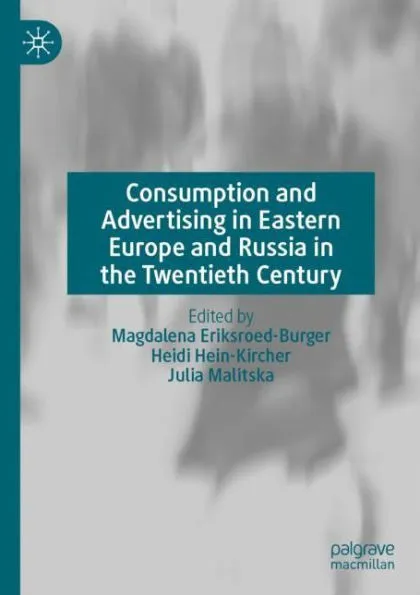
The chapter on the ambivalent place of elite goods, such as furs and chocolate, in the early Soviet ideology of consumption in Ukraine, in Consumption and Advertising in Eastern Europe and Russia in the Twentieth Century (ed. by Heidi Hein-Kircher, Magdalena Eriksroed-Burger, and Julia Malitska) (2023).
To learn more about my publications and research experience, please visit the Publications and explore my profile at Academia.edu.
THANK YOU
My research has benefited significantly from the invaluable support of my colleagues. I am deeply grateful to each of them for their personal encouragement, unwavering support, and stimulating conversations. Additionally, I would like to express my gratitude to the various research grants, fellowships, and academic institutions, that have provided funding for my projects. I am truly thankful for their support in advancing my work.
 Iryna Skubii